Ethical Bird Photography: A Checklist for Getting Close Without Causing Stress
September 28, 2026 - Photography
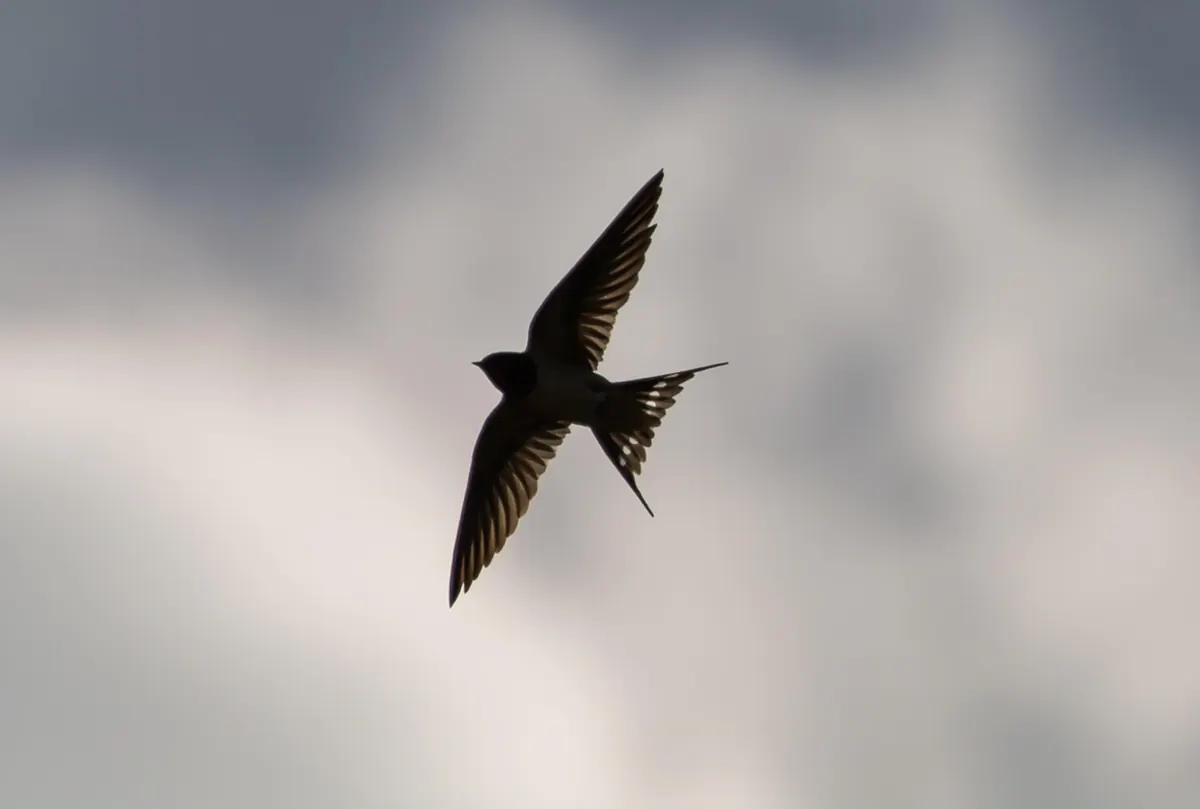
Three birds, one stretch of sky, and a fair amount of squinting. From April onwards, anyone who spends time outdoors in Britain will notice dark, pointed shapes cutting through the air above fields, rooftops, rivers and reservoirs. Swifts, swallows and martins all feed on flying insects, all arrive here from Africa, and all look frustratingly similar when they are fifty metres up with the light behind them.
Watch for a little longer, though, and the differences become surprisingly clear. Each species has its own shape, its own way of moving through the air, and its own calendar. Learn those three things and you will stop guessing.
Swift. The wings are long, narrow and stiff, held in a shallow bow or a scythe-like curve. The body is compact and cigar-shaped, and the tail is short and only slightly forked, often held closed to a point. Against a bright sky the whole bird reads as dark, with no white anywhere.
Swallow. Long, pointed wings swept back like a dart, and a deeply forked tail with two thin streamers trailing behind. That tail is the giveaway: if you can see two wires following the bird, it is a swallow. The body looks slimmer, and the head and shoulders more prominent.
House martin. Shorter, more triangular wings, a neat compact body, and a modestly forked tail. Above all it shows a bright white rump — a small square of white between the back and the tail, visible at distances where colour is hopeless. The underparts are white too, so the bird often flickers pale against a dark background.
Swift. Fast, stiff and flickering. Flurries of rapid wingbeats alternate with long, stiff-winged glides, and the wings never bend loosely at the wrist. The screaming parties of summer evenings — groups racing around rooftops and church towers — are almost always swifts. They also fly highest of the three on warm, clear days.
Swallow. Unhurried and flowing. Deep, elastic wingbeats followed by long glides with the wings swept back. Swallows hunt low, sometimes a metre above grass, water or a farm track, and they perch readily on wires, aerials and dead branches between feeding bouts.
House martin. Busier and more fluttery. The wingbeats whirr almost continuously, with shorter glides between them. House martins often feed higher than swallows, and they return to mud cups under the eaves of houses, hovering briefly at the nest rim.
One rule settles most arguments: a swift never perches. Its legs are tiny and its feet are built for clinging to vertical surfaces, not for gripping a wire. If the bird is sitting on a telegraph line, it is a swallow or a martin.
Swift: uniform sooty brown, looking black in the air. In good light a slightly paler throat patch shows, but there is no white on the body or rump.
Swallow: glossy blue-black above, cream to rufous below, with a deep red throat and forehead and a dark band across the chest.
House martin: blue-black above, clean white below, white rump, and small white feathered feet that you will almost never see. The contrast between dark back and white belly is stronger than in a swallow.
Sand martin: brown above rather than blue-black, white below with a brown band across the chest, and no white rump. If you are standing near a sandy bank, gravel pit or river cliff in spring, this is the one to expect.
The order of arrival is more reliable than any date. Sand martins usually lead, appearing from mid to late March. Swallows and house martins follow in April, sometimes as early as the last days of March. Swifts are the last to arrive, typically late April into early May — hearing the first scream of the year is a genuine milestone.
Departure runs in roughly the same order. Swifts leave first, slipping away through late July and August, and most are gone by the end of that month. Sand martins and swallows follow through September. House martins are usually the last to go, with a few lingering into October, especially in mild autumns. Weather shifts all of this by a week or two either way, so treat the sequence as the constant and the calendar as a rough guide.
Late summer brings juvenile swallows with short, undeveloped tail streamers, so the easiest clue weakens. Look instead for the long swept-back wings and the pale rufous throat. House martins flying high in dull weather can look swift-like, but the white belly flashing and the even, fluttering wingbeats will settle it. Swifts drop low in cold, wet spells, sometimes skimming just above rooftops and water, yet they still hold their wings stiffly and never glide with bent wings.
Silhouettes against grey cloud are the hardest of all. Wait for the bird to cross a lighter patch, or watch it against a building, a tree line or a hill. A few seconds of contrast is worth more than a minute of guesswork.
Skill here comes from repetition, not from field guides. Pick one spot you pass regularly — a garden, a park bench, a bridge, a corner of a reservoir — and use it often.
By the end of a summer you will read the sky without thinking about it. The swifts will leave first, so enjoy them while they are still screaming over the rooftops.
Photo: TheOtherKev / Pixabay

A practical checklist for photographing birds without causing harm, covering fieldcraft, distance, nesting season,...
Bill length, leg colour, call and habitat are enough to separate curlews, whimbrels and both godwits. A practical...
Copyright © 2026 Plume Loop. All Right Reserved.